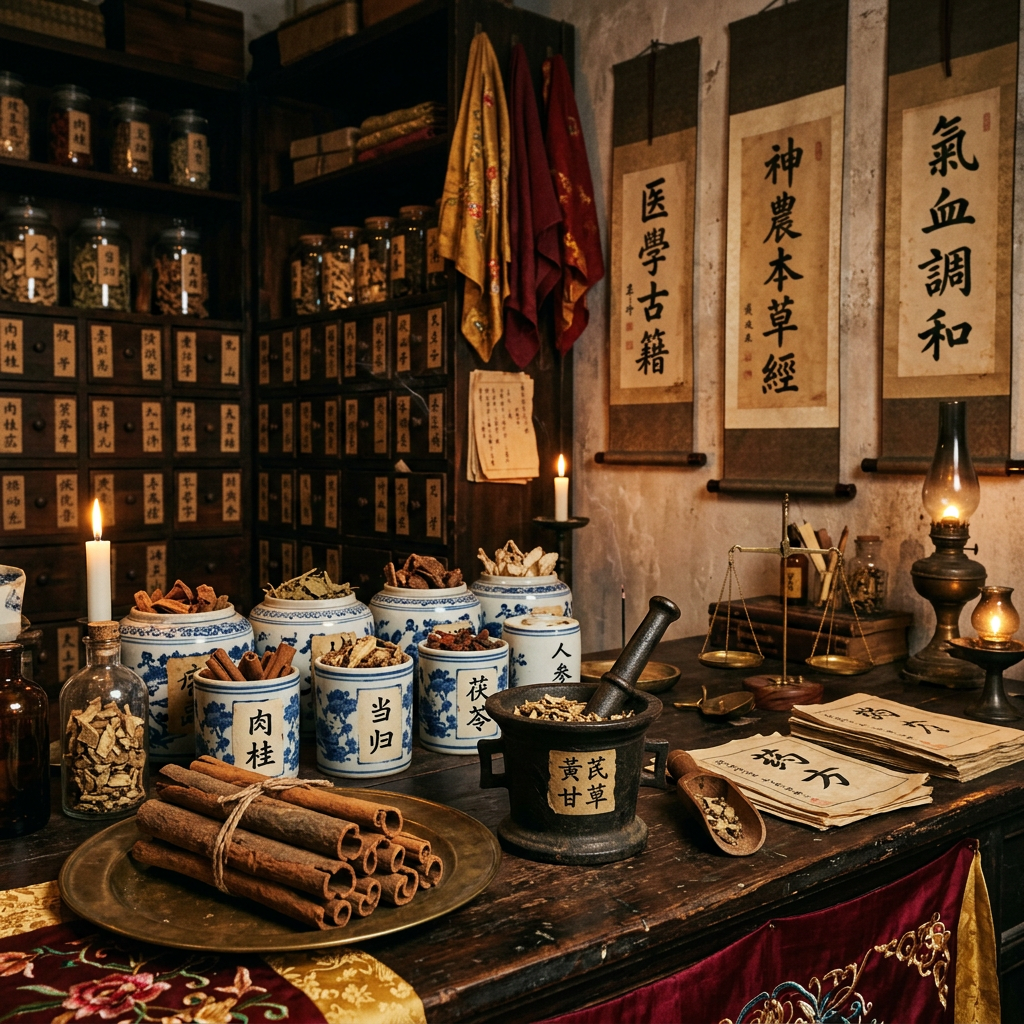
Traditional Chinese Medicine
肉桂 (Ròu Guì) & 桂枝 (Guì Zhī)
Cinnamon in
Chinese Medicine
Over 2,500 years of clinical wisdom from the Shennong Bencao Jing to modern integrative oncology — discover how cinnamon heals through the lens of Qi, Yang, and the Five Elements.
2,500 Years of Wisdom
TCM Theoretical Foundations
In Traditional Chinese Medicine, cinnamon is first documented in the Shennong Bencao Jing(神農本草經, ~200 CE) — the Divine Farmer's Materia Medica — classified as a superior herb (上品). Its actions are understood through Qi, Yin-Yang, the Five Elements, and the Zang-Fu organ systems.
Core TCM Properties of Cinnamon
Nature (性)
Hot (熱)
Hottest of all warming herbs
Taste (味)
Acrid, Sweet (辛甘)
Disperses, tonifies, and harmonizes
Meridians (歸經)
Kidney, Spleen, Heart, Liver
肾脾心肝
Action Class
Tonify Yang, Warm Interior
補陽 · 溫裡散寒
Yang Deficiency
The root indication for cinnamon. Yang deficiency manifests as cold extremities, low back pain, frequent urination, fatigue, and low libido. Cinnamon's hot nature directly replenishes the Kidney Yang (命門之火 — 'Gate of Vitality' fire).
Qi Stagnation
Cinnamon moves and warms Qi, dispersing stagnation in the Middle Jiao (spleen/stomach) and chest. This addresses digestive bloating, chest oppression, and menstrual pain caused by cold obstructing the free flow of Qi.
Cold Pathogen
As a supremely warm herb (hot in nature), cinnamon expels interior cold that has penetrated the channels and organs. This mechanism underlies its use in painful joints, cold-type abdominal pain, and dysmenorrhea.
Blood Deficiency
Cinnamon twig (Gui Zhi) warms and promotes Blood circulation, addressing patterns of cold blood stagnation causing pale complexion, cold menstrual pain with clots, and numbness in extremities.
Two Distinct Herbs
Ròu Guì vs. Guì Zhī
Chinese medicine distinguishes two cinnamon herbs with meaningfully different properties — from the same tree, but with different clinical applications.
Cinnamon Bark
肉桂
Ròu Guì
The thick inner bark, harvested from mature trees (8–10 years old). Considered the most powerfully warming medicinal in TCM. It directly supplements the Kidney Yang — the foundational fire (命門火) that drives all physiological processes.
Primary Actions
- ▸ Warms and tonifies the Kidney & Spleen Yang
- ▸ Disperses deep interior cold
- ▸ Warms the channels, relieves pain
- ▸ Leads fire back to its source (引火歸原)
- ▸ Encourages generation of Qi and Blood
Typical Dose
1–5g per day in decoction (added at end to preserve volatile oils)
Classic Indications
Cinnamon Twig
桂枝
Guì Zhī
Young twigs of the cinnamon tree, with a gentler warming nature. Where Rou Gui goes deep to the Kidneys, Gui Zhi works on the surface, channels, and Heart. It is one of the most frequently used herbs in classical formulas (Zhang Zhongjing used it in over 70 formulas).
Primary Actions
- ▸ Releases the Exterior, warms the channels
- ▸ Unblocks Yang Qi in the chest and limbs
- ▸ Warms and moves Blood stagnation
- ▸ Assists Heart Yang (palpitations, chest pain)
- ▸ Transforms thin mucus (饮), warms the bladder
Typical Dose
3–9g per day in decoction
Classic Indications
Organ System Therapeutics
Benefits by Organ System
TCM treats the whole person through organ systems (Zang-Fu). Here is how cinnamon heals each system, with classical texts and modern correlates.
Kidney System (腎)
Kidney Yang Deficiency (腎陽虛)
Key Symptoms Treated
- · Cold lower back and knees
- · Impotence or infertility
- · Frequent pale urination
- · Ringing in ears
- · Hair loss
- · Low libido
- · Fear/anxiety with cold presentation
Modern Correlate
Hypothyroidism, adrenal fatigue, testosterone deficiency, chronic fatigue
TCM Mechanism & Science
Rou Gui's extremely hot nature penetrates to the Kidney to rekindle the Ming Men fire (命門火 — the 'Gate of Vitality'). In Five Element theory, Kidney corresponds to Water, and cinnamon's fire energy warms this water, restoring vitality. Cinnamaldehyde has been shown to upregulate steroidogenesis and improve Leydig cell function, offering a modern explanation.
"Rou Gui mainly treats upper qi rushing up (上氣), treats coughing, harmonizes the center, benefits the joints, invigorates the nine orifices, and penetrates to the blood vessels." — Shennong Bencao Jing
Spleen-Stomach System (脾胃)
Spleen Yang Deficiency / Cold Invading the Middle (中寒)
Key Symptoms Treated
- · Chronic loose stools or diarrhea
- · Bloating, especially after eating
- · Nausea with cold food
- · Poor appetite
- · Fatigue after meals
- · Cold sensations in the abdomen
Modern Correlate
IBS-C, hypothyroid gut, gastroparesis, chronic diarrhea, malabsorption
TCM Mechanism & Science
The Middle Jiao (Spleen and Stomach) requires warmth to transform and transport food. Cold injures the Spleen's transforming function. Cinnamon's acrid-warm nature enters the Spleen meridian to dry dampness, warm the Middle, and promote the Spleen's upward-bearing function. Modern research confirms it improves gastric emptying and reduces pathogenic gut bacteria.
"For cold pain in the heart and abdomen, breaking Qi stagnation, warming the body, treating all cold-type Bi (painful obstruction) syndromes." — Ben Cao Gang Mu (李時珍, 1578)
Heart System (心)
Heart Yang Deficiency / Chest Bi (胸痹)
Key Symptoms Treated
- · Palpitations with cold sensation in chest
- · Shortness of breath worse in cold
- · Pale or bluish lips
- · Cold extremities with purple hue
- · Chest oppression
- · Fear/anxiety with cold
Modern Correlate
Bradycardia, heart failure with cold signs, atrial fibrillation, Raynaud's
TCM Mechanism & Science
Gui Zhi enters the Heart meridian to warm and unblock the chest Yang. The Heart governs Blood — when Yang is deficient, Blood stagnates causing the 'chest painful obstruction' (胸痹) pattern. Multiple classical formulas (e.g. Gualou Xiebai Guizhi Tang) address this. Cinnamaldehyde's vasodilating and antiplatelet effects confirm this mechanism.
"Gui Zhi treats upper rushing Qi, intermittent fever and chills, harmonizes the Ying and Wei levels." — Shennong Bencao Jing
Liver & Blood (肝·血)
Cold Stagnation in the Liver Channel / Blood Stasis with Cold (寒凝血瘀)
Key Symptoms Treated
- · Painful menstruation with dark clots
- · Cold sensation in lower abdomen relieved by heat
- · Irregular periods
- · Infertility with cold presentation
- · Testicular cold pain in men
- · Purple or dark menstrual blood
Modern Correlate
Dysmenorrhea, endometriosis, uterine fibroids, PCOS, varicocele
TCM Mechanism & Science
The Liver meridian traverses the genitalia and lower abdomen. Cold contracting the Liver channel impedes Blood flow, causing pain. Cinnamon warms this channel, promoting smooth Qi and Blood movement. The combination with blood-moving herbs (e.g. in Wen Jing Tang) addresses endometriosis and dysmenorrhea. Clinical trials confirm significant menstrual cycle improvement with cinnamon.
"Treats women's metrorrhagia, cold conditions in the uterus, breaks Qi accumulations." — Ben Cao Gang Mu
Lung System (肺)
Wind-Cold Invasion / Phlegm-Cold in the Lungs (風寒·痰飲)
Key Symptoms Treated
- · Chills greater than fever
- · No sweating (or slight sweating)
- · Clear/white nasal discharge
- · Body aches
- · Cold-triggered asthma
- · Clear/white phlegm
Modern Correlate
Common cold (wind-cold type), asthma with cold triggers, chronic rhinitis, bronchitis
TCM Mechanism & Science
Gui Zhi is a key herb in releasing the Exterior (解表) in Wind-Cold patterns. It opens the pores, promotes sweating, and helps the Lung disperse pathogenic cold. Combined with Bai Shao (white peony), it harmonizes the Ying and Wei levels — the body's immune defensive system. Modern research shows cinnamaldehyde's significant antiviral and anti-inflammatory effects on airway tissue.
"Gui Zhi Tang (桂枝湯) — cinnamon twig decoction — is the most fundamental formula for regulating the body's Ying and Wei levels." — Shang Han Lun, Zhang Zhongjing (~220 CE)
Channels & Collaterals (經絡)
Cold Bi Syndrome (寒痹) / Painful Obstruction
Key Symptoms Treated
- · Joint pain worse in cold, better with warmth
- · Stiff joints in the morning
- · Fixed, severe pain (cold causes contraction)
- · Cold, pale, or purple extremities
- · Numbness in hands and feet
Modern Correlate
Rheumatoid arthritis (cold-type), osteoarthritis, fibromyalgia, peripheral neuropathy
TCM Mechanism & Science
Cold is a contracting pathogen that blocks the free flow of Qi and Blood in the channels. Bi syndrome describes painful obstruction from Wind, Cold, or Dampness blocking the meridians. Cinnamon expels cold from the channels, promotes circulation, and relieves pain. It is central to formulas like Juan Bi Tang and Du Huo Ji Sheng Wan. Its anti-inflammatory actions on COX-2 and prostaglandins align with this.
"For all cold-type Bi syndromes, cinnamon is indispensable to warm the channels and expel the pathogen." — Yi Xue Zhong Zhong Can Xi Lu (Zhang Xichun, 1918)
Classical Formulas
Famous Cinnamon Formulas
Cinnamon appears in dozens of the most important classical prescriptions from Zhang Zhongjing's Shang Han Lun and Jin Gui Yao Lue (1,800 years ago) — still used in clinics worldwide today.
Guì Zhī Tāng
Cinnamon Twig Decoction
Composition
Classical Indications
The foundational formula for Wind-Cold exterior patterns with sweating, chills greater than fever, and body aches. Also used to harmonize the Ying and Wei levels in chronic deficiency.
Modern Clinical Use
Common cold (wind-cold type), low-grade fever with sweating, autoimmune conditions with cold signs, chronic fatigue
Shèn Qì Wán
Kidney Qi Pill
Composition
Classical Indications
Kidney Yang deficiency with cold lower back and knees, fatigue, impotence, infertility, frequent urination at night, and edema. Rou Gui assists Fu Zi in warming the Ming Men fire.
Modern Clinical Use
Hypothyroidism, chronic kidney disease, adrenal fatigue, osteoporosis, sexual dysfunction, nocturia
Wēn Jīng Tāng
Warm the Menses Decoction
Composition
Classical Indications
Cold stagnation in the uterus causing irregular menstruation, dysmenorrhea with dark clots, infertility, and persistent mild vaginal bleeding. Classic formula for cold-type gynecological disorders.
Modern Clinical Use
Dysmenorrhea, endometriosis, uterine fibroids, PCOS, infertility, irregular menses, premature ovarian failure
Xiǎo Jiàn Zhōng Tāng
Minor Construct the Middle Decoction
Composition
Classical Indications
Middle Jiao deficiency with cold abdominal pain (better with warmth and pressure), palpitations, fatigue, and spontaneous sweating. Warms and tonifies the Spleen and Stomach.
Modern Clinical Use
IBS, duodenal ulcers, functional abdominal pain, chronic gastritis, fatigue with digestive weakness, anemia
Líng Guì Zhú Gān Tāng
Poria, Cinnamon, Atractylodes & Licorice Decoction
Composition
Classical Indications
Spleen Yang deficiency with accumulation of phlegm-fluids (痰飲), causing palpitations, dizziness, shortness of breath, and a sensation of water sloshing in the stomach.
Modern Clinical Use
Congestive heart failure, BPPV (vertigo), Meniere's disease, hypothyroid edema, chronic fluid retention
Dāng Guī Sì Nì Tāng
Tangkuei Decoction for Frigid Extremities
Composition
Classical Indications
Blood and Yang deficiency causing cold hands and feet (frigid extremities), pale or purple discoloration, and cold pain in the abdomen and lower back.
Modern Clinical Use
Raynaud's syndrome, peripheral neuropathy, frostbite susceptibility, chilblains, cold-type dysmenorrhea, thromboangiitis
Who Should Use Cinnamon?
The 9 Constitutions of TCM
TCM tailors treatment to your unique constitutional type. Cinnamon is not for everyone — knowing your constitution is key to safe and effective use.
Yang Deficiency (陽虛體質)
The primary constitution for cinnamon use. These individuals feel cold easily, have cold hands and feet, prefer warmth, and have low energy. Their tongue is pale with a white coating, pulse is deep and slow.
Common Signs
- Always cold, especially in winter
- Low energy, needs extra rest
- Prefers warm food and weather
- Pale face
- Loose stools
- Low sex drive
Recommendation
Rou Gui 1–3g daily in warm water or tea. Can combine with ginger. Ideal constitutional medicine.
Qi Deficiency (氣虛體質)
Those with Qi deficiency have fatigue, shortness of breath, low immune function, and easy sweating. Cinnamon twig warms and moves Qi, helping restore energetic vitality when combined with Qi tonics.
Common Signs
- Chronic fatigue
- Gets sick easily
- Shortness of breath on exertion
- Spontaneous sweating
- Weak voice
- Prolapse tendency
Recommendation
Gui Zhi 3–6g combined with Huang Qi (astragalus) and Ren Shen. Avoid alone in large doses.
Blood Stasis (血瘀體質)
Characterized by dark complexion, dark lips, varicosities, fixed stabbing pain, and dark menstrual blood. When cold is the root cause of blood stasis, cinnamon is excellent. When heat causes stasis, avoid.
Common Signs
- Dark or purple complexion
- Dark circles under eyes
- Varicose veins
- Fixed pain in one location
- Dark purple menstrual clots
- Spider veins
Recommendation
Gui Zhi in formulas with Dang Gui and Chuan Xiong. Only when cold is causing the stasis.
Phlegm-Dampness (痰濕體質)
Overweight with heavy, sluggish feeling, oily skin, profuse phlegm, and heaviness in limbs. Cinnamon warms the Spleen to transform dampness and phlegm, addressing the root of this constitution.
Common Signs
- Overweight or tendency to gain weight
- Heavy, sluggish sensation
- Oily skin and scalp
- Profuse phlegm/mucus
- Chest oppression
- Sweet/sticky taste in mouth
Recommendation
Ling Gui Zhu Gan Tang formula. Gui Zhi 6–9g with Fu Ling and Bai Zhu.
Yin Deficiency (陰虛體質)
Hot constitution with night sweats, dry mouth, afternoon heat, and insomnia. Cinnamon's hot nature can aggravate these symptoms. Small doses with yin-nourishing herbs may be appropriate in specific presentations.
Common Signs
- Feels hot, especially at night
- Night sweats
- Dry mouth and throat
- Insomnia
- Red cheeks
- Restlessness
Recommendation
Generally avoid high doses. If used, combine with Shu Di, Bai Shao, and Mai Dong to counterbalance. Use only in complex formulas.
Damp-Heat (濕熱體質)
Hot, damp constitution with yellow secretions, bitter taste, acne, and infections. Cinnamon's hot nature would add fuel to the fire in most cases. Avoid unless specifically indicated by a TCM practitioner.
Common Signs
- Acne and oily skin
- Yellow phlegm or discharge
- Bitter taste
- Scanty dark urine
- Infections and inflammation
- Irritability
Recommendation
Avoid cinnamon supplementation. This constitution requires cooling, dampness-clearing herbs instead.
Practical TCM Applications
How to Use Cinnamon the TCM Way
Beyond swallowing capsules — classical preparation methods that maximize cinnamon's therapeutic potential according to time-tested TCM practices.
Cinnamon Tea (肉桂茶)
The simplest daily practice. Steep 1 cinnamon stick (or ½ tsp ground cinnamon) in hot water for 10 minutes. Add honey and ginger for enhanced Yang-tonifying effect. Best taken in the morning to kindle Yang energy for the day.
TCM Principle: Warming tea activates the Spleen's 'transforming and transporting' function and disperses morning cold stagnation.
Cinnamon & Ginger Foot Soak (泡腳)
Add 2 cinnamon sticks and 3 slices of fresh ginger to hot water foot bath. Soak for 20–30 minutes before bed. Particularly effective for cold feet, insomnia from Yang deficiency, and improving circulation.
TCM Principle: The Kidney meridian starts in the foot (Yongquan point KD-1). Warming the feet directly tonifies Kidney Yang — a classical practice in TCM.
Topical Warming Oil (外敷)
Dilute cinnamon essential oil (1-2%) in a carrier oil (sesame oil, which is also warming in TCM). Apply to the lower back (Ming Men area), abdomen, or painful joints to expel local cold and relieve pain.
TCM Principle: Sesame oil (胡麻油) is also warming and nourishing in TCM, making it the ideal carrier to synergize with cinnamon's channel-warming properties.
Cinnamon Congee (肉桂粥)
Add 1–2g of powdered Rou Gui to warm congee (rice porridge) with Chinese dates (Da Zao) and ginger. A classic nourishing breakfast for Yang-deficient constitutions, especially in winter or after illness.
TCM Principle: Congee (粥) is considered the most easily digestible food in TCM, gently supporting Spleen Qi. Adding cinnamon warms the Middle Jiao while congee replenishes essence.
Cinnamon & Honey Paste (蜂蜜肉桂)
Mix ½ tsp Ceylon cinnamon with 1 tsp raw honey. Take on an empty stomach in the morning or apply topically to acne and wounds. Honey (甘甜性平) harmonizes cinnamon's heat and nourishes Yin simultaneously.
TCM Principle: Honey is classified as sweet and neutral in TCM, tonifying the Middle Jiao and lubricating the intestines. It moderates cinnamon's intense warmth for safer daily use.
Cinnamon in Cooking (藥食同源)
The concept of Yao Shi Tong Yuan (藥食同源 — 'medicine and food share the same source') underlies TCM's culinary medicine. Add cinnamon to stews, broths, and rice dishes. Classic pairings: star anise + cinnamon in braised meats; cinnamon + cardamom in warming soups.
TCM Principle: Cooking cinnamon with Kidney-nourishing foods (black beans, walnuts, lamb) creates synergistic organ-targeting food medicine.
Where Ancient Meets Modern
TCM Patterns → Modern Science
Remarkably, modern biochemistry is now explaining the precise molecular mechanisms behind TCM clinical observations made thousands of years ago.
TCM Diagnosis
Kidney Yang Deficiency → Ming Men Fire depleted
Modern Pathophysiology
Hypothalamic-Pituitary-Adrenal axis dysregulation; reduced steroidogenesis; low testosterone/cortisol
Research Evidence
Cinnamaldehyde upregulates StAR protein and CYP17A1, key enzymes in steroid hormone synthesis (Zhao et al., 2017)
TCM Diagnosis
Spleen's 'transforming and transporting' function impaired by cold
Modern Pathophysiology
Impaired glucose transporter (GLUT4) translocation; insulin receptor substrate dysfunction
Research Evidence
MHCP from cinnamon mimics insulin, activating IR/IRS-1 signaling and GLUT4 membrane translocation (Imparl-Radosevich et al., 1998)
TCM Diagnosis
Cold blood stagnation in channels (寒凝血瘀)
Modern Pathophysiology
Platelet aggregation, thromboxane-mediated vasoconstriction, reduced nitric oxide bioavailability
Research Evidence
Cinnamaldehyde inhibits TXA2-mediated platelet aggregation and upregulates eNOS for vasodilation (Dhuley, 1998)
TCM Diagnosis
Heart Yang deficiency → Chest Bi (胸痹)
Modern Pathophysiology
Endothelial dysfunction, coronary artery spasm, reduced cardiac output in cold conditions
Research Evidence
Cinnamon extract improves endothelial function markers (FMD) and reduces LDL oxidation (Davis & Yokoyama, 2011)
TCM Diagnosis
Wind-Cold invading the Exterior → Wei Qi weakness
Modern Pathophysiology
Innate immune suppression; viral adhesion to host cells; insufficient interferon response
Research Evidence
Cinnamaldehyde inhibits viral neuraminidase and enhances NK cell cytotoxicity (Hayashi et al., 2007)
TCM Diagnosis
Yang Qi failing to warm and transform water → edema (水腫)
Modern Pathophysiology
Impaired aquaporin function; reduced Na+/K+ ATPase activity; aldosterone excess
Research Evidence
Cinnamon polyphenols modulate aldosterone signaling and improve renal tubular function (Huang et al., 2015)
Continue Exploring
See All 16 Proven Health Benefits
Return to the main research guide for detailed clinical trials, nutrition data, dosage guidelines, and more.
View Full Research Guide